
Analysis → Insights → Decision-Making
What does the DIVA Decision Support System do?
It transforms territorial data into practical tools for planning, policy design, and resource allocation.
The system supports evidence-based decision-making through structured indicators, analytical outputs, and actionable insights.
By integrating spatial analysis, indicator systems, and visualization tools, the system enables faster interpretation of territorial dynamics.
It supports more effective planning and decision-making processes.
This process is operationalized through a structured and integrated data pipeline.
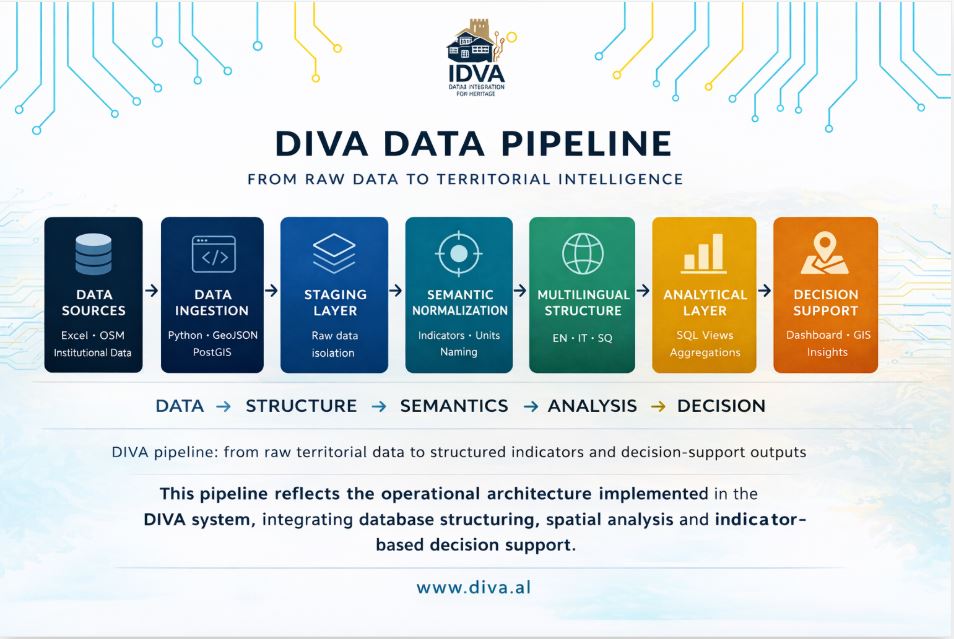
The DIVA pipeline represents the operational architecture of the system, connecting data ingestion, semantic structuring, analytical processing, and decision-support outputs.
It reflects the integration of database design, spatial analysis, and indicator-based modeling within a unified territorial intelligence framework.
Understanding Territorial Dynamics Through Data
The DIVA system transforms structured territorial data into decision-oriented knowledge. Through the integration of indicator frameworks, spatial analysis, and analytical processing, it supports a comprehensive understanding of territorial dynamics.
By reducing data fragmentation and improving analytical clarity, the system enables institutions to identify priorities, compare scenarios, and design targeted development strategies.
From Data to Insights
Structured territorial data is processed into indicators, aggregated, and analyzed to produce meaningful insights. This step transforms raw information into a comparable and interpretable format.
From Insights to Decisions
Analytical outputs are translated into decision-support elements such as rankings, comparisons, and performance evaluations, directly supporting governance and planning processes.
Experience DIVA in Action
Discover how structured territorial data can be transformed into decision-ready intelligence. The DIVA platform integrates indicators, spatial analysis, and visualization tools to support real-world planning and policy decisions.