
Un Percorso Unico per l'Analisi Territoriale
DIVA Methodology: Data for Informed Decision-Making
DIVA is a digital platform (system) designed to support decision-making in territorial and sectoral planning. It is based on an original methodology that deliberately avoids abstract theoretical approaches, which are unfortunately common in many similar tools (Landscape Arch. Matteo Guccione).
Each element of the methodology is designed to be documentable, measurable, and replicable.
Discover the DIVA Methodology
The IDVA methodology is an operational “territorial intelligence” approach that transforms heterogeneous data into concrete tools for analysis and decision support. The term “territorial intelligence” is used here to describe an operational, data-based approach to territorial analysis and decision support, not intelligence in a geopolitical or security sense.
DIVA is not limited to data collection, but defines a structured, traceable, and replicable process that connects data, territory, and public policies through open digital tools.
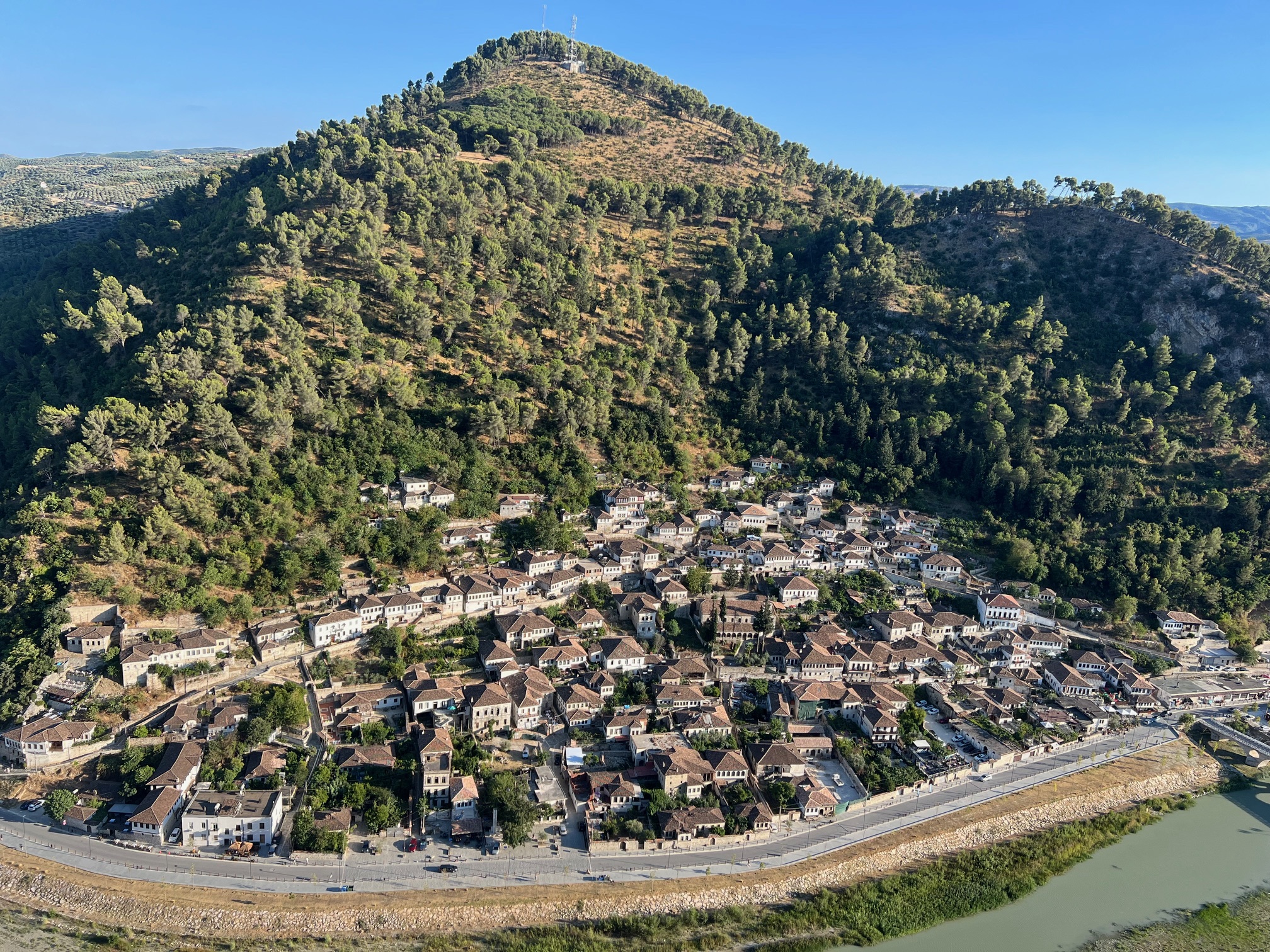
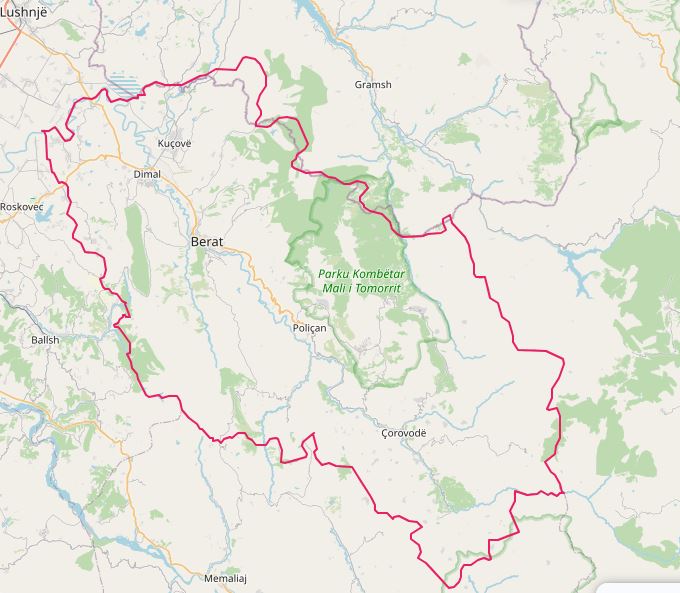
Each phase of the methodology has been tested in the field in collaboration with the Municipality of Berat as a pilot project and is documented through databases, GIS maps, validated indicators, and verifiable outputs.
Strategic Alignment with the Sustainable Development Goals (SDGs)
Within the DIVA framework, territorial indicators are not derived from the SDGs themselves, but are analytically interpreted and mapped in coherence with the SDGs.
The SDGs are used as an international reference framework to ensure transparency, comparability and methodological alignment across different territorial contexts.
This approach allows locally grounded indicators to be read within a shared global framework, without altering their empirical origin or their territorial specificity.
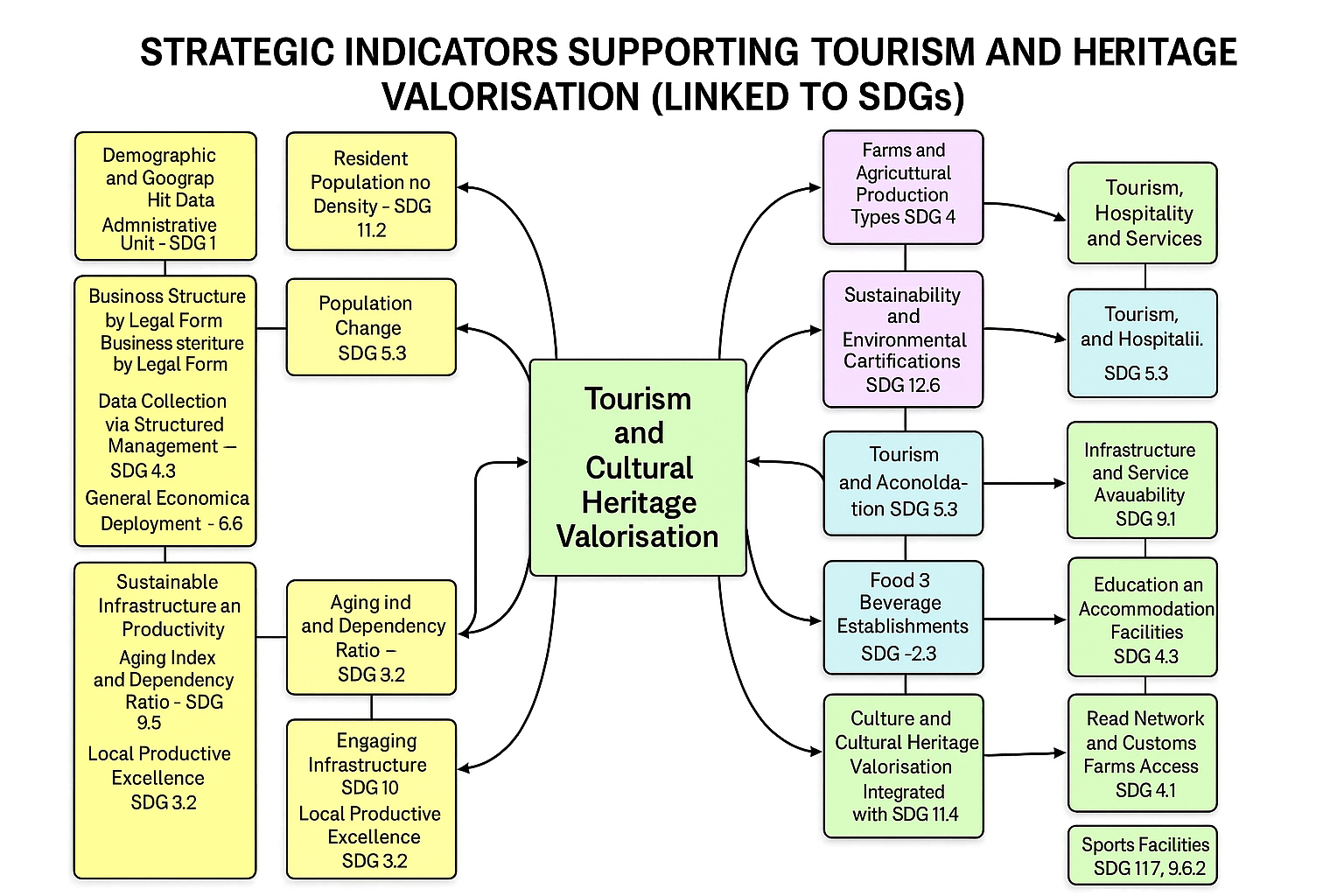
The diagram illustrates how strategic territorial indicators supporting tourism and cultural heritage valorisation can be coherently linked to relevant SDGs.
This mapping does not imply the creation of SDG indicators, but highlights the analytical correspondence between territorial data and internationally recognised development objectives.
Key Features of the DIVA Methodology
Scientific Coherence
The DIVA methodology adopts selection and analysis criteria based on scientific standards and comparable indicators.
Each data point is integrated into a structured model that ensures consistency, readability, and comparability over time and across different territories.
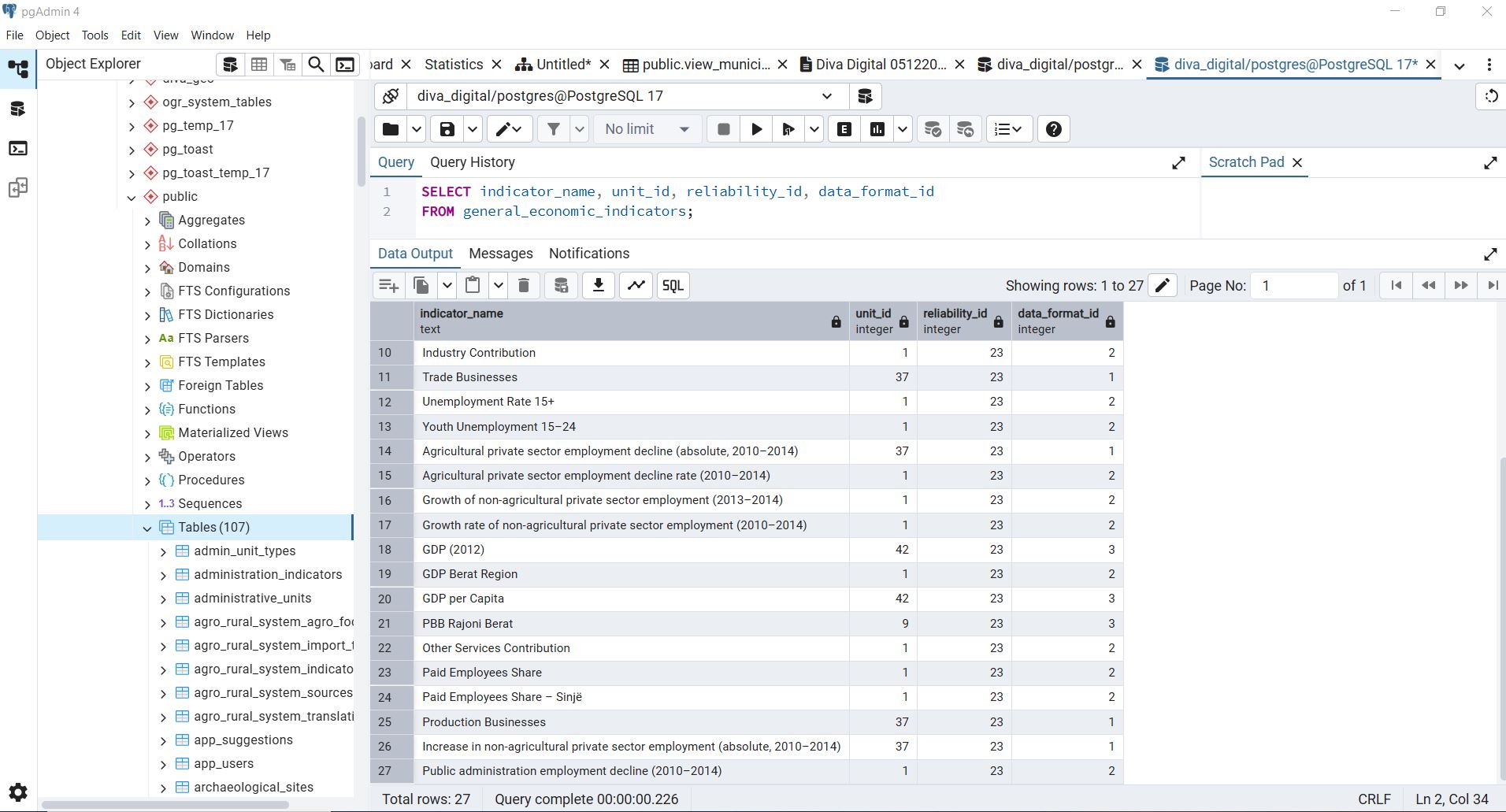
Illustrative examples of data querying and visualization.
Source Traceability
Each indicator is accompanied by clear information on its source, reliability level, and context of use.
Traceability is not an accessory, but an essential condition for the use of data in decision-making, institutional, and strategic contexts.
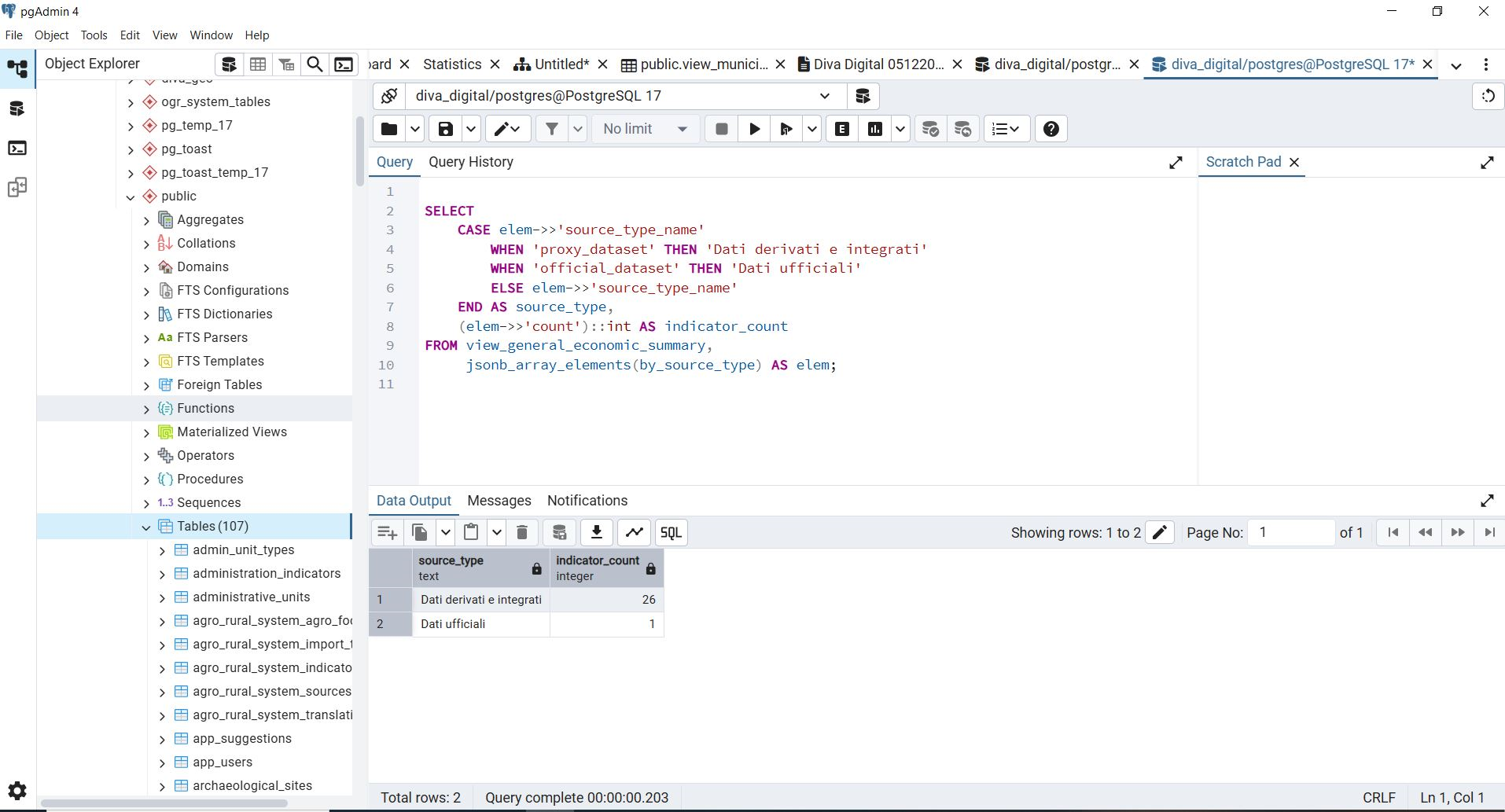
Illustrative examples of data querying and visualization.
Direct Integration
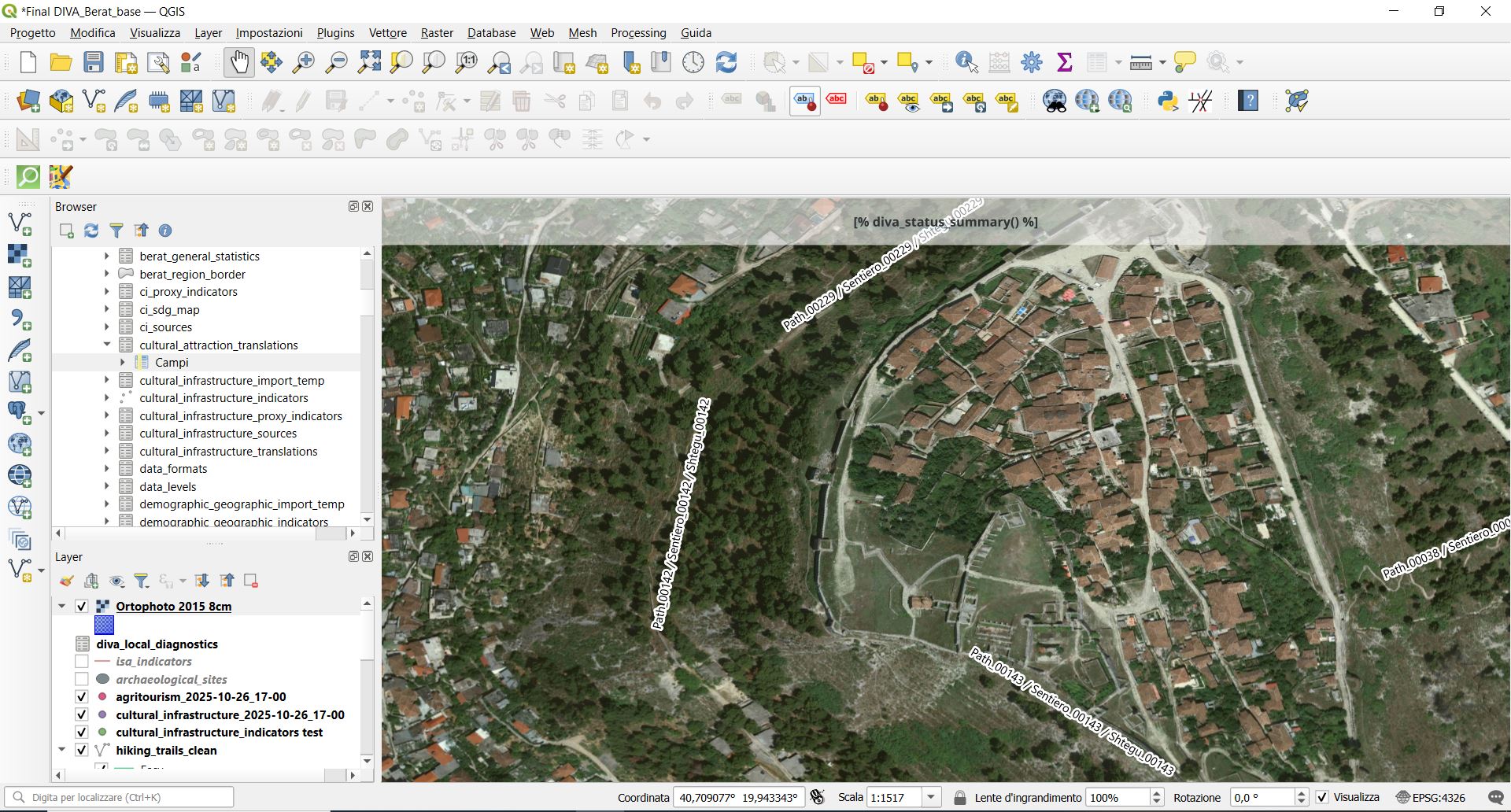
DIVA natively integrates relational database (ERD), GIS systems, and web platforms.
This enables a seamless transition from data collection to cartographic visualization, through to analysis and delivery via dashboards and digital applications.
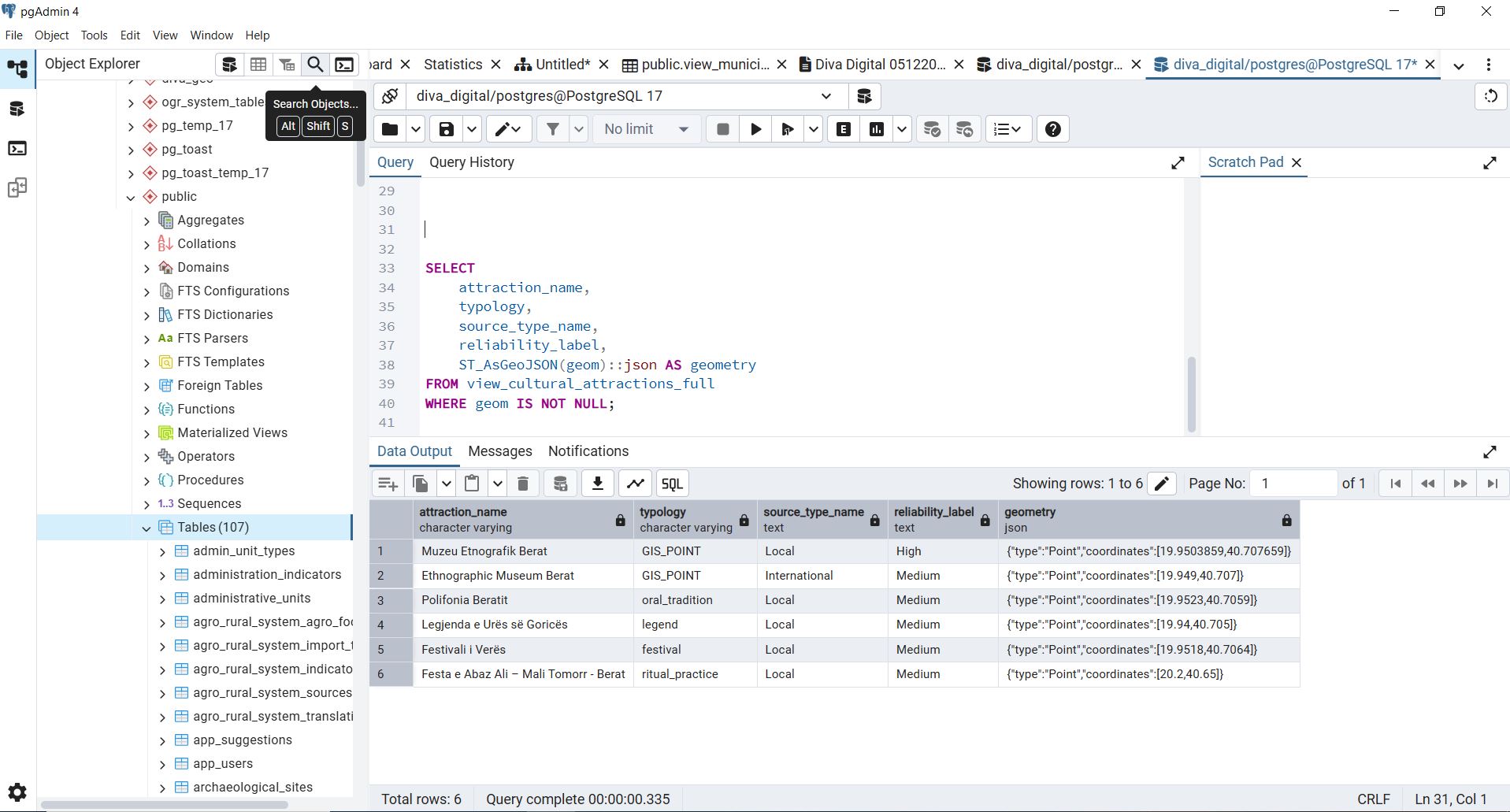
Illustrative examples of data querying and visualization.
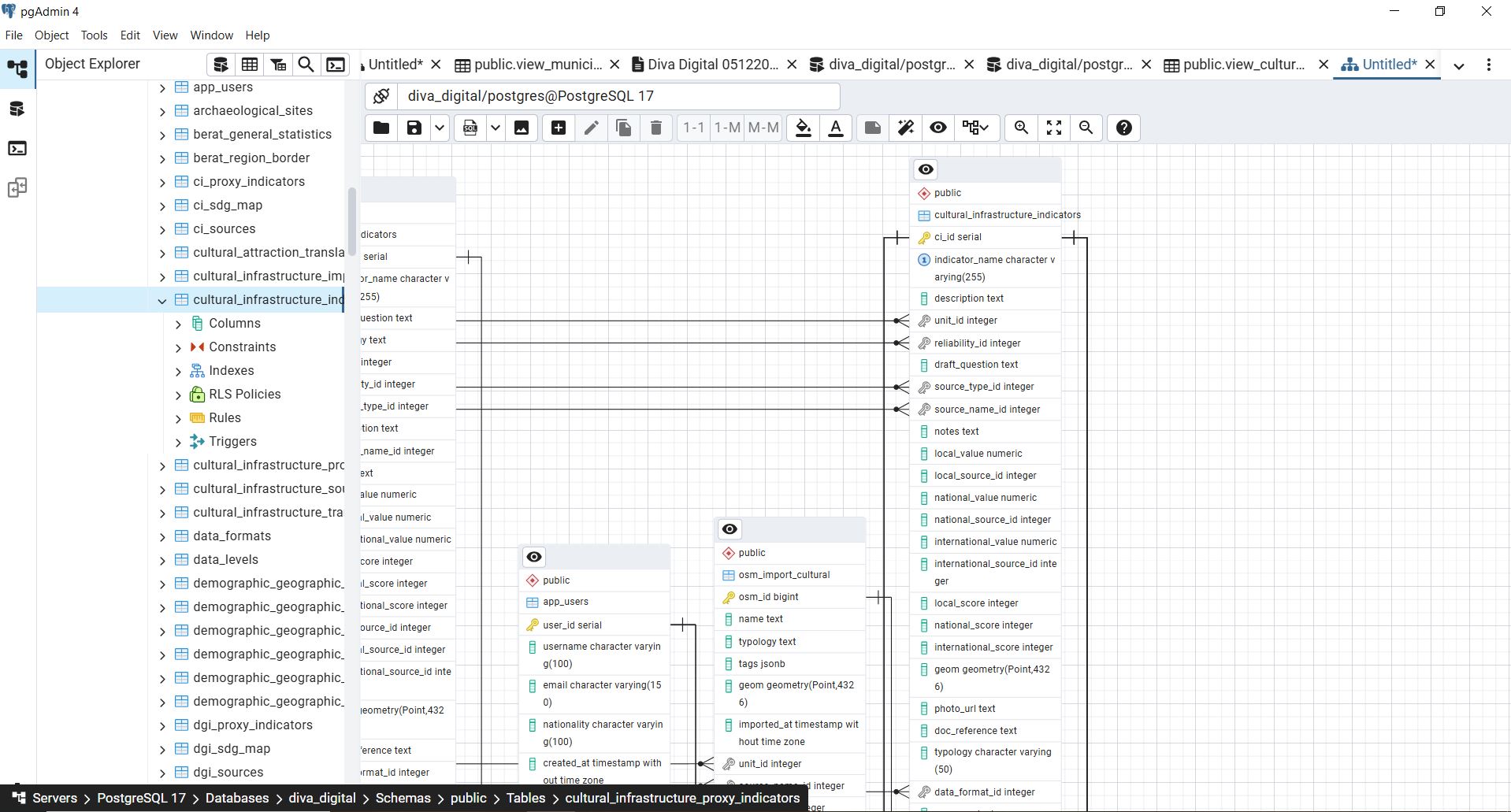
Illustrative examples of data querying and visualization.
How It Works
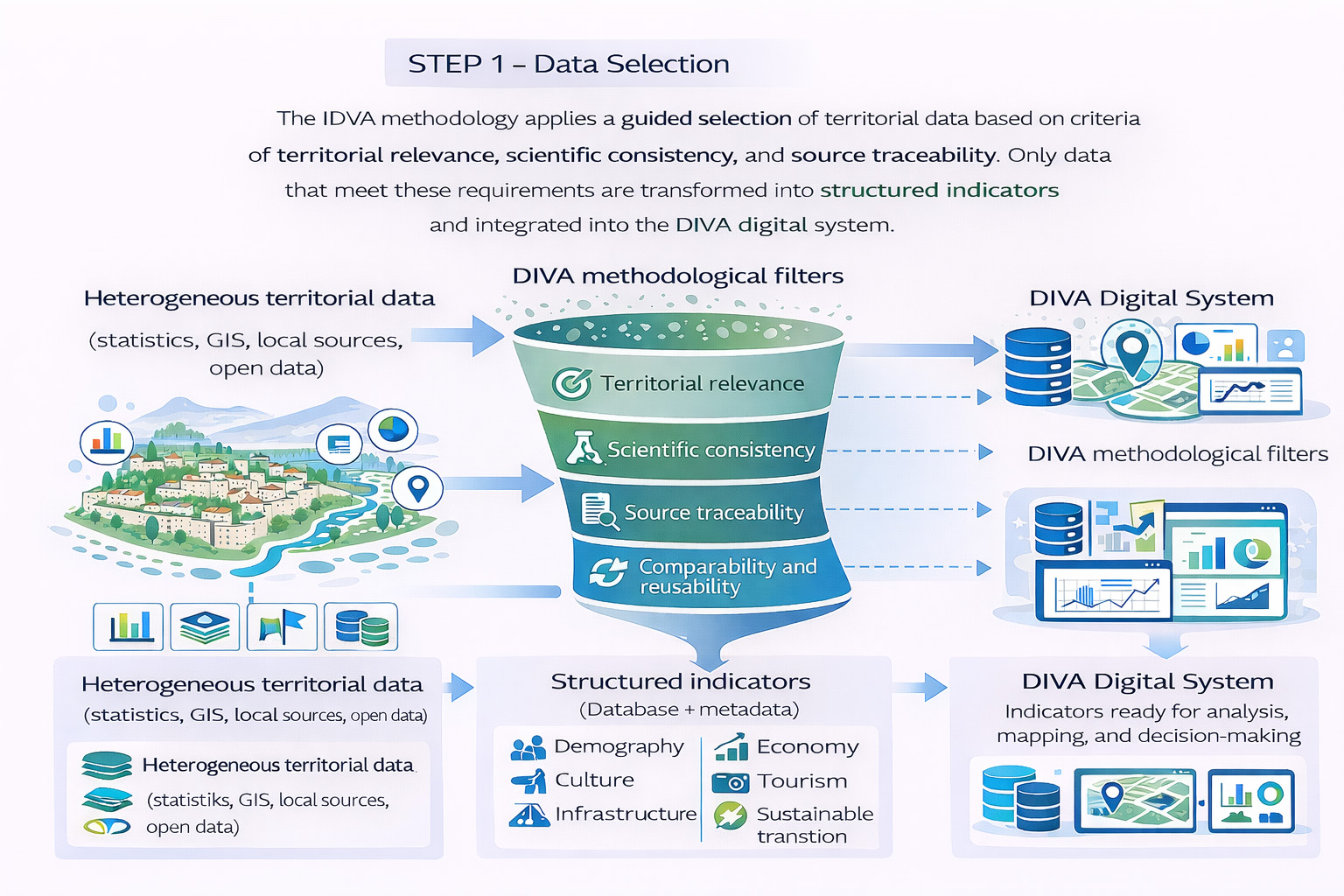
Step 1
Data Selection
Territorial data are selected based on their relevance to planning, local development, and territorial valorization.
The selection is carried out through indicators structured by thematic category, avoiding random or redundant data collection.
Step 2
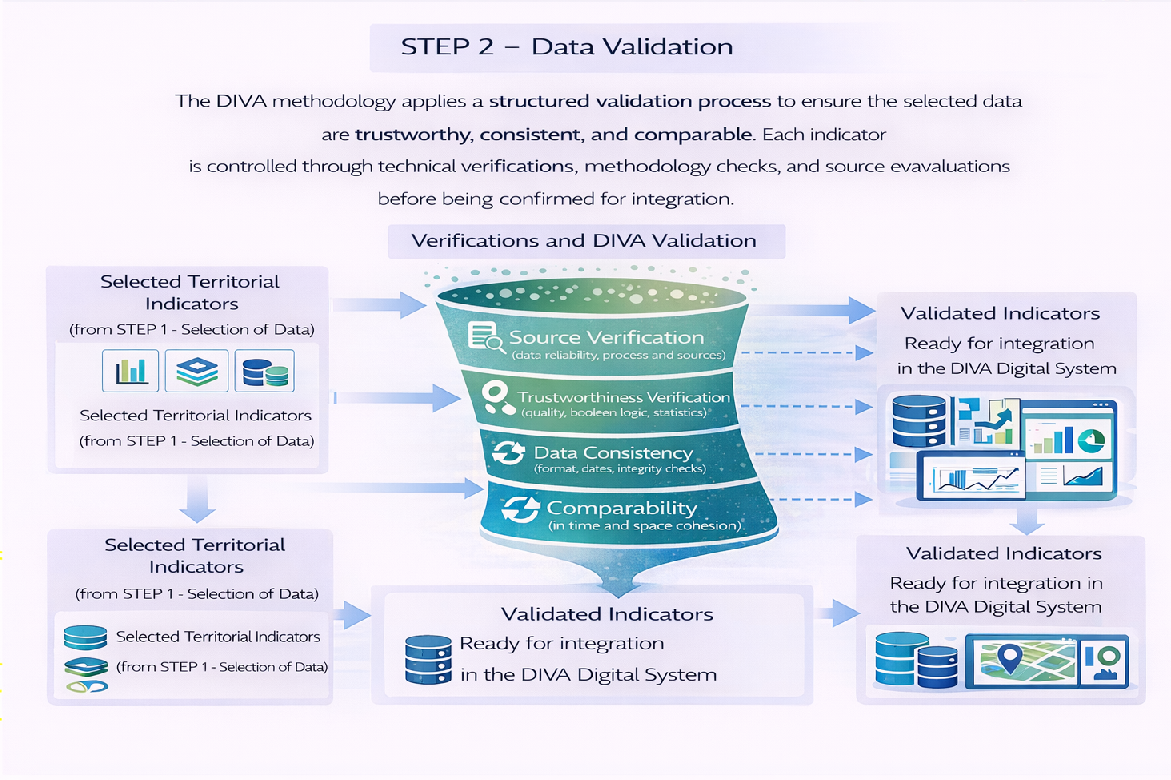
Data Validation
Selected data are subjected to consistency, reliability, and completeness checks.
Each indicator is validated in relation to its source, data format, and compatibility with the overall system.
Step 3
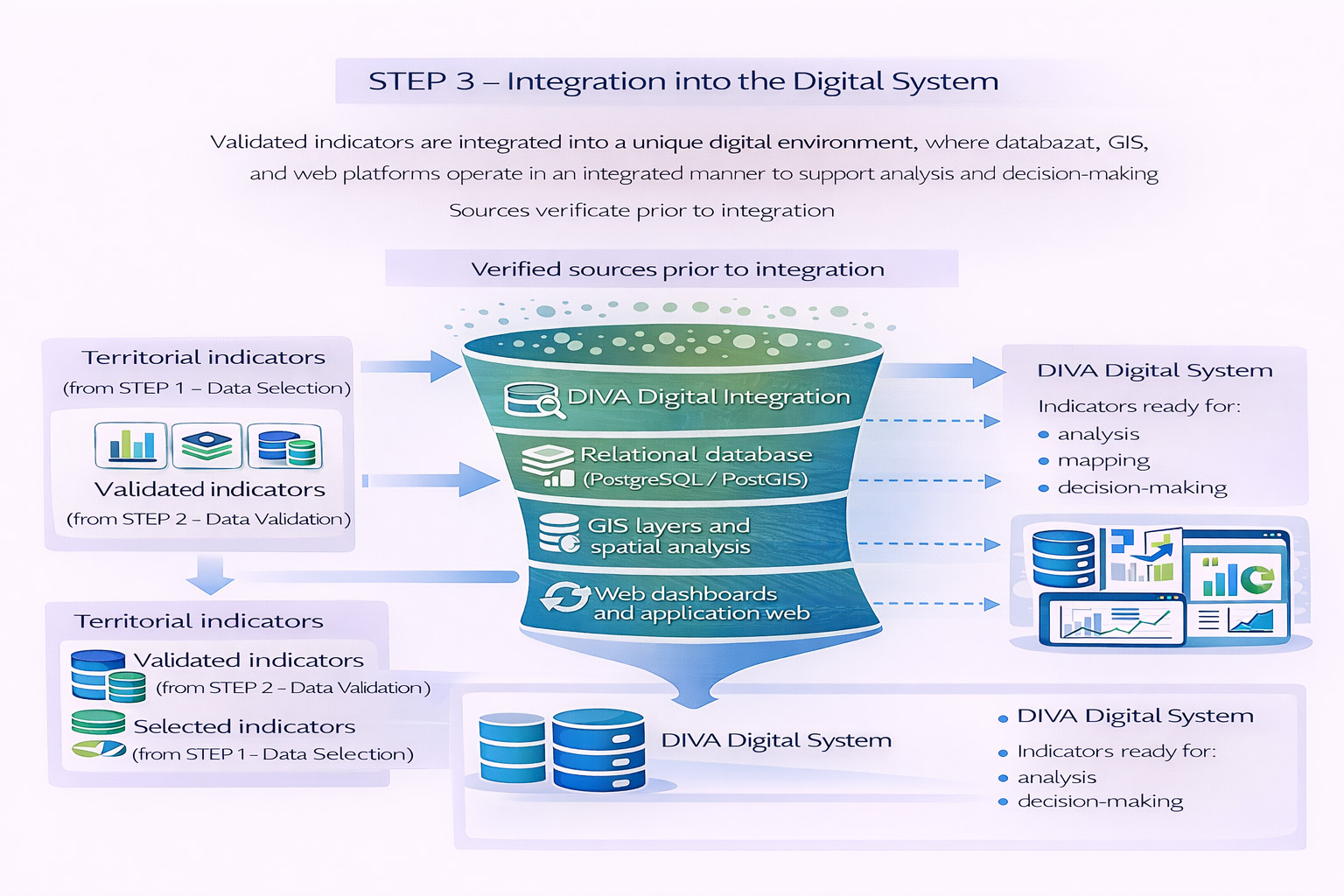
Integration into the Digital System
Validated data are integrated into a single digital system, designed for territorial analysis, thematic map production, and support for public and private decision-making.
The system is designed to be updatable, extensible, and reusable in other territorial contexts.
Faster and more reliable data-driven decisions
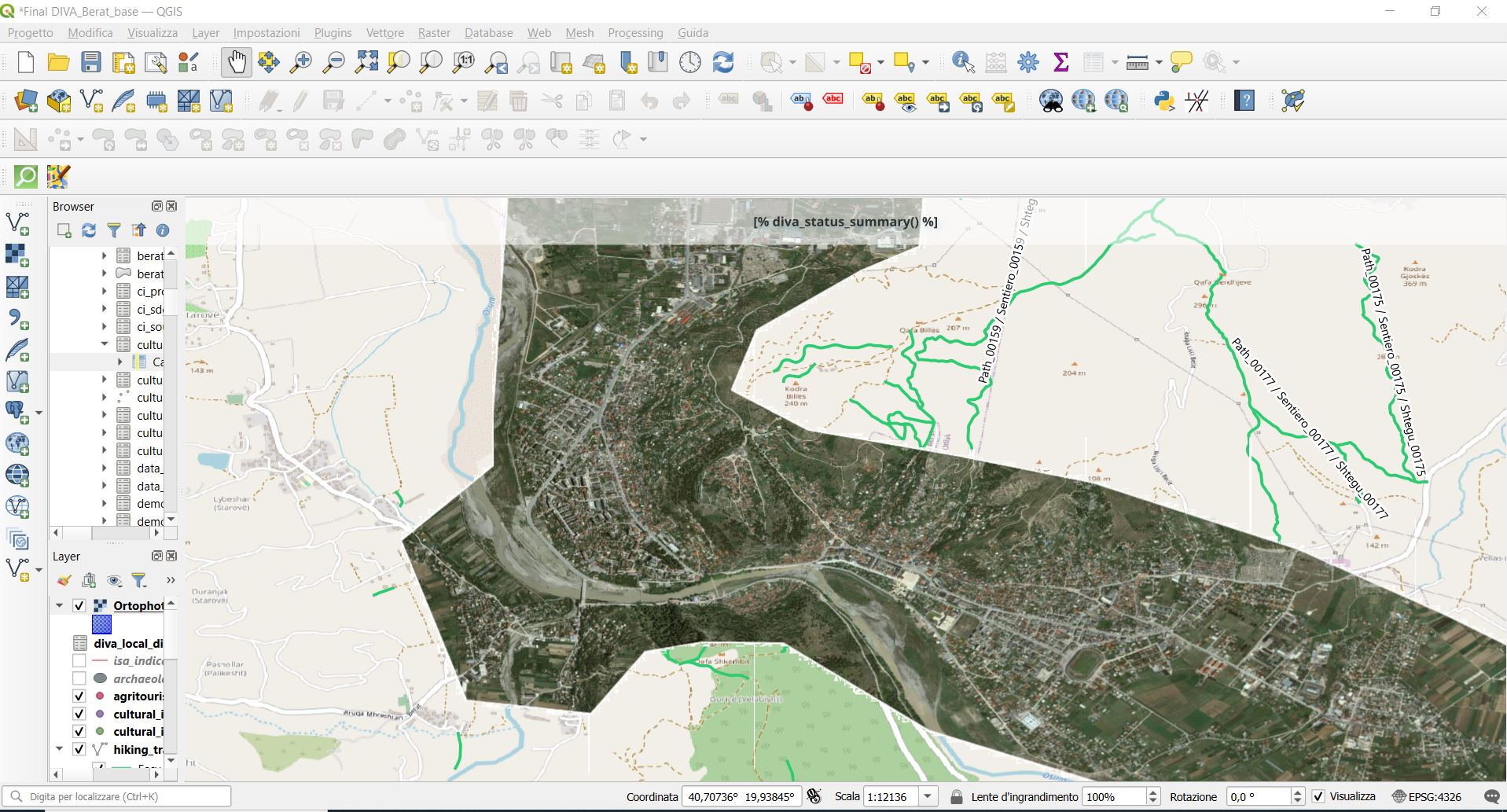
Territorial Analysis
DIVA provides territorial analyses based on real data, structured indicators, and spatial representations.
These analyses support strategic planning, sustainable development policies, and the valorization of local heritage.
Decision Support
Through dashboard, maps, and structured datasets, the DIVA methodology helps institutions, local authorities, and communities make informed, transparent, and evidence-based decisions.
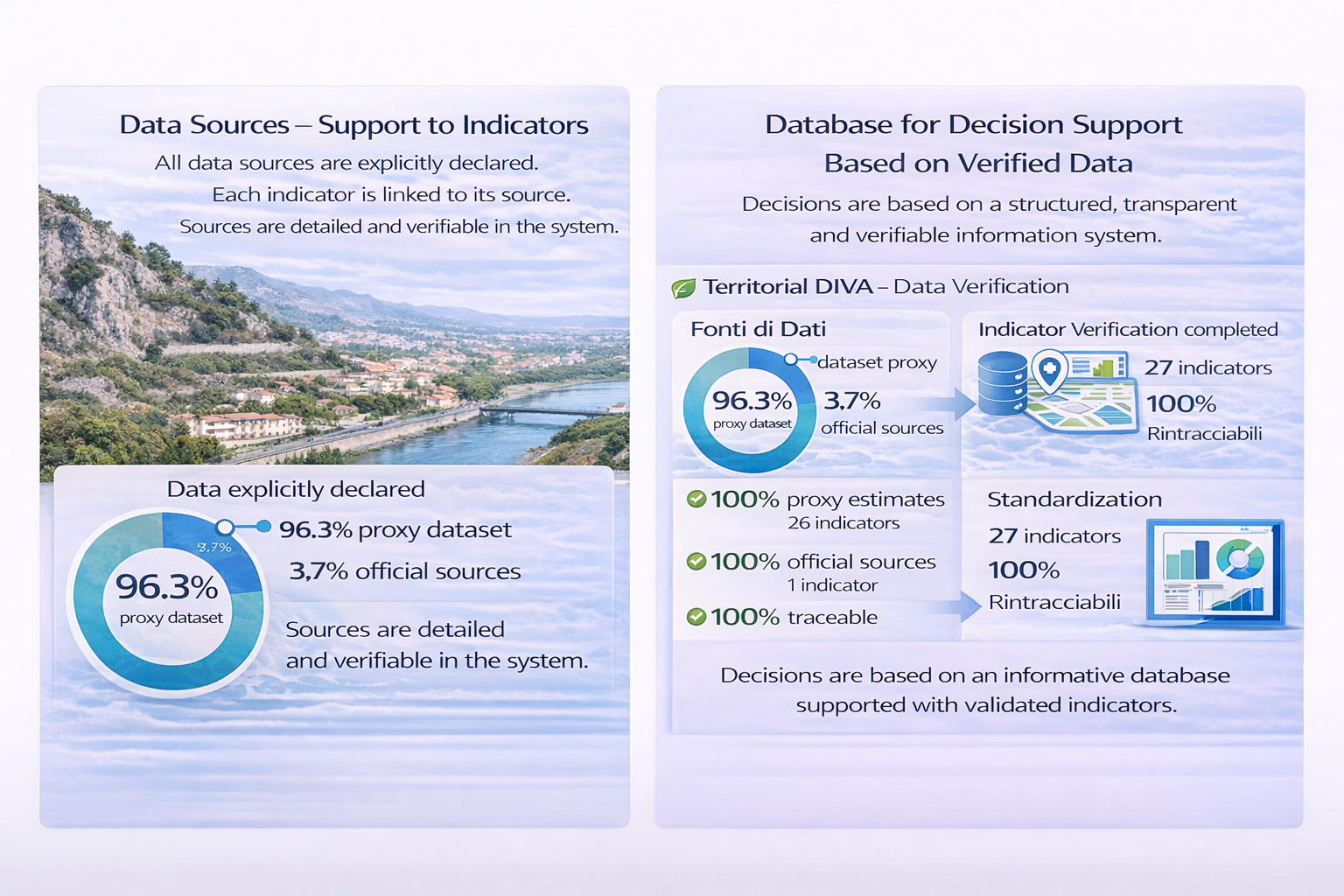
Artificial Intelligence as Analytical Support
Artificial intelligence within the DIVA system represents an advanced analytical tool for the interpretation of territorial data, enhancing the understanding and management of the territory.
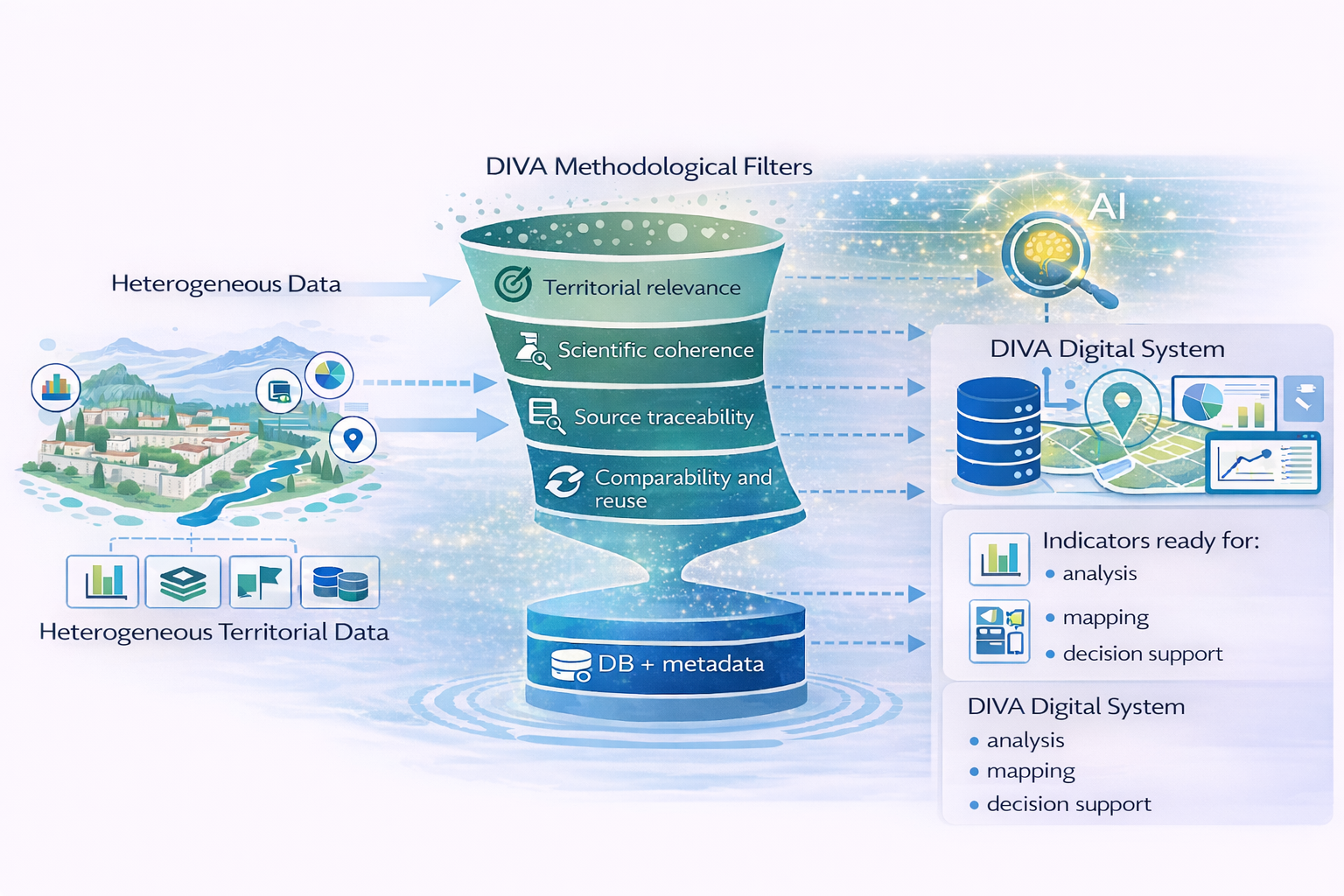
Advanced Data Analysis
The system (DIVA) leverages AI algorithms to uncover hidden correlations among different indicators, facilitating strategic planning and resource management.
Decision Support
Thanks to artificial intelligence, DIVA provides analytical suggestions that help institutions make informed decisions based on concrete and reliable data.
Transparency and Verifiability
Each analysis generated is linked to the original data sources, ensuring a high level of transparency and the ability to verify every result.
Integration and Adaptability
The system is designed to be easily integrated with other tools and adaptable to different territorial contexts, promoting a flexible and scalable approach.
The Power of Data
Data-Driven Decisions in Tourism
Introduction
This example shows how data collected by local offices can be transformed, through the IDVA system, into concrete support for public decision-making in the tourism and hospitality sector.
1. Initial data (offices and statistical sources)
Local offices use established operational tools to collect essential data on tourism and hospitality. These data include information on active accommodation facilities, available bed capacity, annual tourist arrivals, and the resident population. Currently, the data are managed in separate Excel spreadsheets, without automatic links between indicators, which requires significant manual effort for analysis.
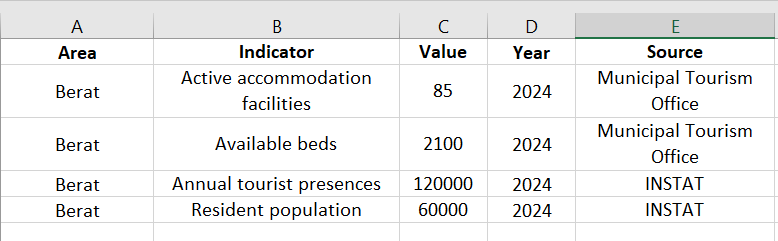
2. DIVA System – Structured and Verified Data
The data are imported into the IDVA system, where:
-
they are structured into homogeneous indicators
-
they are accompanied by declared sources
-
they are associated with explicit reliability levels
-
they become comparable over time and across space
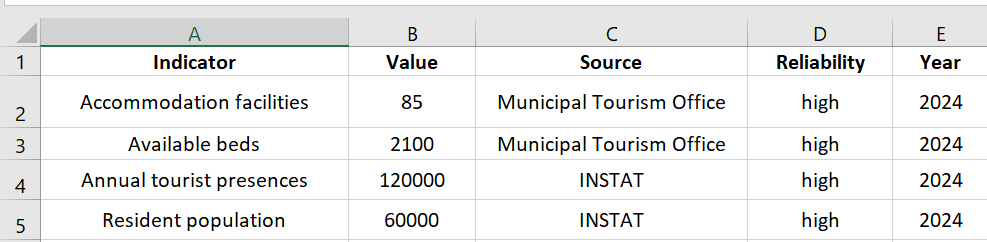
The system ensures that all data used are traceable and verifiable.
3. Automatically Processed Key Indicators
Without introducing new data, the DIVA system enables the processing of synthetic indicators useful for decision-making, such as:
-
Tourist arrivals per bed → ≈ 57
-
Accommodation facilities per inhabitant → ≈ 1 per 700 residents
-
Tourist arrivals per inhabitant → ≈ 2
Analyses of this kind, using traditional methods, would require days or weeks of manual work.
4. Territorial analysis
The indicators are integrated with the GIS system, enabling immediate spatial interpretation.
Territorial analysis shows that:
-
a significant share of accommodation facilities is concentrated in the historic center
-
peripheral and rural areas experience tourist flows but have limited accommodation supply
-
the territorial distribution of supply is not consistent with potential demand
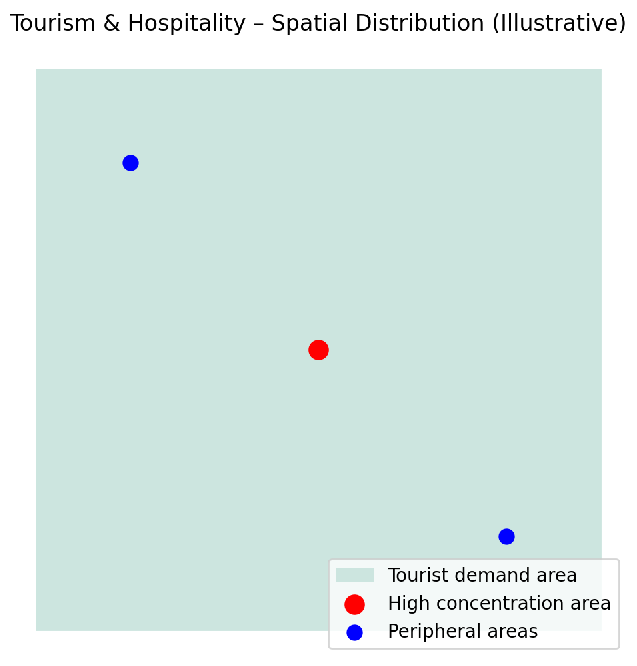
The map allows immediate identification of imbalances and critical issues.
5. Evidence-Based Public Decision-Making
Based on the analysis, the administration can make informed decisions, such as:
-
Encouraging new accommodation facilities and tourism services in peripheral areas with good accessibility, reducing pressure on the historic center and promoting a more balanced distribution of economic benefits.
The overall analysis time is reduced from weeks to less than one hour.
Conclusion
DIVA transforms heterogeneous data collected by offices into operational tools for territorial analysis, significantly reducing decision-making time and increasing the reliability of public choices.
Testimonials
“Thanks to the DIVA methodology, we have significantly improved the management of our territory.”
“DIVA has enabled us to integrate complex data into an easy-to-use system, improving our efficiency.”
“With DIVA, we have been able to make faster decisions based on reliable data.”